Below is a free Road & Traffic Signs mock test for the UK DVSA car theory test: multiple-choice questions in the official four-option format, each with the correct answer, a plain-English explanation and a Highway Code reference. The largest topic in the bank: signs, signals, road markings and their meanings.
Road & Traffic Signs practice questions
Checked against The Highway Code as amended · last reviewed . Spotted an error? Report it.
Q1. What shape are most warning signs on UK roads?
- Circular
- Triangular
- Rectangular
- Octagonal
Answer: B. Triangles warn, circles give orders, rectangles inform. Knowing the shape system lets you read a sign's purpose even at a distance or when partly obscured. Reference: Know Your Traffic Signs; The Highway Code — Traffic signs
Q2. What do circular road signs with a blue background generally tell you?
- A warning of a hazard ahead
- Something you must not do
- A positive instruction — something you must do
- Tourist information
Answer: C. Blue circles give positive instructions, such as 'turn left ahead' or a mandatory minimum speed. Red-ringed circles tell you what you must not do. Reference: The Highway Code — Traffic signs
Q3. You pass a white circular sign with a black diagonal stripe on a road where a central reservation separates the two directions of traffic. What's the maximum speed for a car?
- 60 mph
- 50 mph
- 70 mph
- It depends on how many lanes there are
Answer: C. The sign means the national speed limit applies. A road with a central reservation separating the carriageways is a dual carriageway, where the national limit for cars is 70 mph. On a single carriageway it would be 60 mph. The limit depends on the type of road, not the number of lanes. Reference: The Highway Code — rule 124; Dual carriageways
Q4. Double yellow lines along the edge of the road mean what?
- No waiting at any time
- No overtaking allowed
- Loading permitted for 20 minutes
- Parking allowed after 6pm
Answer: A. Double yellow lines mean no waiting at any time, unless signs indicate seasonal restrictions. You may stop briefly to let passengers in or out. Reference: The Highway Code — Waiting and parking, rule 238
Q5. Why does the STOP sign have an octagonal shape, unlike most signs that give orders?
- It's a deliberate exception to the usual shape rules, to give it greater prominence
- Because it is the oldest sign design still in use
- To show you only need to stop if traffic is approaching
- Octagonal signs are cheaper to manufacture
Answer: A. Most signs follow a shape code: circles give orders, triangles warn and rectangles inform. STOP and GIVE WAY are deliberate exceptions to that code, shaped differently so they stand out more. Reference: Know Your Traffic Signs
Q6. What does this sign mean?
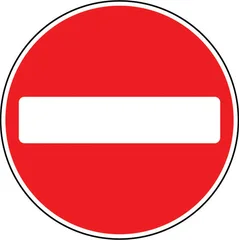
- No entry for vehicular traffic
- No overtaking
- Road closed to pedestrians
- One-way street begins
Answer: A. The red circle with a white horizontal bar means no entry for vehicles. You'll see it at the exit end of one-way streets and slip roads — driving past it puts you head-on into traffic. Reference: The Highway Code — Signs giving orders
Q7. What does this sign mean?
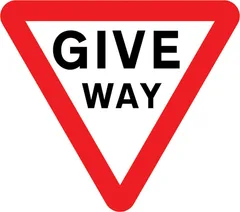
- Stop completely, even if the road is clear
- Give way to traffic on the major road ahead
- You have priority at the junction ahead
- Roadworks ahead
Answer: B. The inverted triangle means give way: slow down, be ready to stop, and let traffic on the major road pass first. Unlike a STOP sign, you need not stop if the way is clear. Reference: The Highway Code — rule 172 and Signs giving orders
Q8. What does this sign mean?
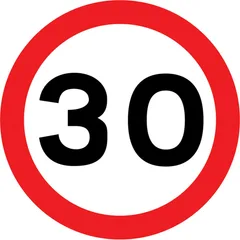
- Minimum speed 30 mph
- Maximum speed 30 mph
- Distance to hazard: 30 metres
- Route number 30
Answer: B. A number inside a red ring is a maximum speed limit order. A blue circle with a white number would be a minimum speed limit — the colour tells you which. Reference: The Highway Code — rule 124 and Signs giving orders
Q9. What does this blue circular sign with a white arrow mean?
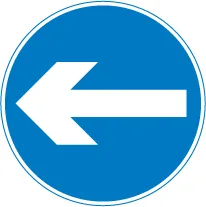
- Left turn recommended
- No left turn
- You must turn left
- Parking area to the left
Answer: C. Blue circles give positive orders — things you must do. A straight white arrow pointing left is the 'Turn left' sign, so turning left is compulsory, not optional. The 'Turn left ahead' sign is different: its arrow bends to the left. Reference: The Highway Code — Signs giving orders
Q10. What does this sign mean?
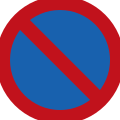
- No stopping at any time
- No waiting
- End of restricted zone
- Clearway ends ahead
Answer: B. A blue disc with a red ring and one diagonal means no waiting — you may stop briefly to pick up or set down passengers. Two crossed diagonals would mean no stopping at all (a clearway). Reference: The Highway Code — Signs giving orders; rule 238
Q11. What does this sign mean?
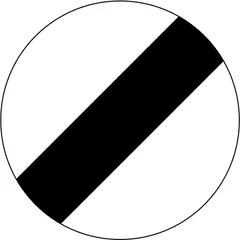
- No speed limit applies
- National speed limit applies
- End of motorway regulations
- No through road
Answer: B. The white circle with a black diagonal stripe means the national speed limit applies: 60 mph for cars on single carriageways, 70 mph on dual carriageways and motorways — lower when towing. Reference: The Highway Code — rule 124 and Signs giving orders
Q12. What must you do at this sign?
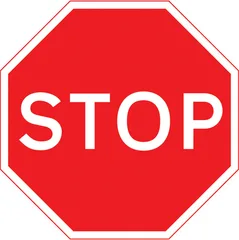
- Slow down and proceed if clear
- Stop completely at the line, even if the road looks clear
- Stop only when other vehicles are approaching
- Give way to traffic from the right only
Answer: B. STOP means a full stop at the solid white line every time — the sign is used where visibility is so limited that rolling through is dangerous even when the road seems clear. Reference: The Highway Code — rule 171
Q13. What does this warning sign mean?
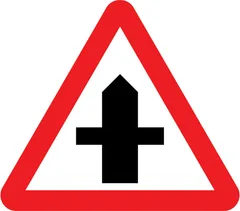
- Hospital ahead
- Level crossing ahead
- Crossroads ahead
- No entry to the junction ahead
Answer: C. A warning triangle with a cross symbol means a crossroads is ahead. Warning triangles alert you to hazards — this one tells you to watch for traffic emerging from both sides. Reference: Know Your Traffic Signs — Warning signs
Q14. What does this warning sign mean?
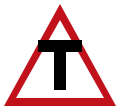
- T-junction ahead — the road you're on ends
- No through road
- Two-way traffic ahead
- Roadworks ahead
Answer: A. The T symbol warns the road ahead ends at a junction where you'll have to turn left or right — start planning your approach speed and position early. Reference: Know Your Traffic Signs — Warning signs
Q15. What does this warning sign mean?
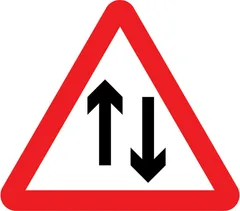
- One-way street ahead
- Two-way traffic straight ahead
- Overtaking permitted
- Contraflow bus lane
Answer: B. Opposing arrows warn that two-way traffic is ahead — often where a one-way system or dual carriageway ends. Expect oncoming vehicles where there were none. Reference: Know Your Traffic Signs — Warning signs
Q16. This circular sign is blue with a white 30. What does it mean?
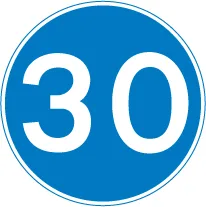
- Maximum speed 30 mph
- Minimum speed 30 mph
- Route 30 begins
- 30 metres to the next junction
Answer: B. Blue circles give positive orders: a white number on blue is a minimum speed limit, which you must keep to unless it's impracticable or unsafe to do so. A red-ringed number is a maximum. Reference: The Highway Code — Signs giving orders
Q17. What does this sign with two crossed red diagonals mean?
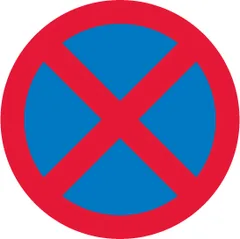
- No waiting
- No stopping at any time — a clearway
- No parking during the day
- End of restriction
Answer: B. Crossed diagonals mean no stopping (a clearway) — you may not even stop to set down passengers. One diagonal would mean no waiting, which does allow brief passenger drop-off. Reference: The Highway Code — rule 240 and Signs giving orders
Q18. You're driving on a dual carriageway and see this sign. What does it warn you about?
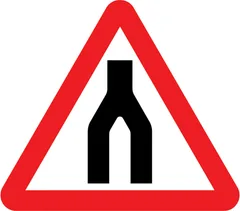
- The road narrows on both sides ahead
- Traffic will merge from the left
- Two-way traffic crosses your road
- The dual carriageway ends ahead
Answer: D. Two lanes joining into one road show the end of the dual carriageway. From here, expect oncoming traffic on the same carriageway with no central reservation between you, so plan any overtaking far more carefully. Reference: The Highway Code — Traffic signs
Q19. What does this sign mean?
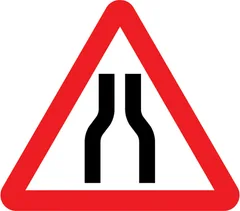
- The dual carriageway ends
- The road narrows on the right only
- The road narrows on both sides
- Single-file traffic in each direction
Answer: C. Both edge lines bend inwards, so the road gets narrower on each side. Slow down and be ready to meet oncoming vehicles in the reduced space. If only one line bent inwards, the sign would warn of narrowing on that side only. Reference: The Highway Code — Traffic signs
Q20. What does this warning sign tell you?
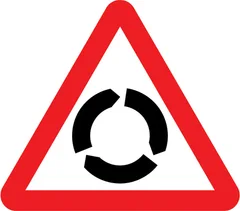
- There's a roundabout ahead
- A one-way system begins ahead
- Traffic calming for half a mile
- A turning area for large vehicles
Answer: A. The red triangle warns and the circular arrows show a roundabout ahead. Reduce speed, choose your lane early and be ready to give way to traffic from your right. A blue circle with arrows is a different, mandatory sign marking a mini-roundabout. Reference: The Highway Code — Traffic signs
Q21. What does this sign warn of?
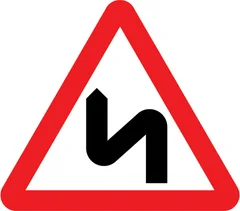
- A double bend, first to the right
- The road narrows on the left
- A sharp deviation of route to the left
- A double bend, first to the left
Answer: D. Read the symbol from the bottom up: the road bends left first, then right. Get your speed right before the first bend. If the symbol were reversed, the first bend would be to the right. The sign may also warn of a series of bends. Reference: The Highway Code — Traffic signs
Q22. You see this sign on a town road. What does it warn you of?
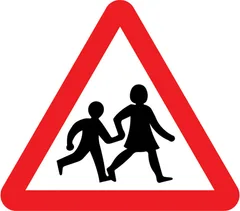
- A zebra crossing is just ahead
- Children going to or from school
- People walking in the road with no pavement
- Entrance to a pedestrian-only zone
Answer: B. Two children in a red triangle warn that children are likely to be going to or from a school or playground nearby. Slow down and watch for them stepping out. It's a warning, not a crossing, so children may appear anywhere along the road. Reference: Know Your Traffic Signs
Q23. What should you be ready for after passing this sign?
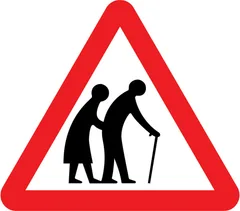
- Children crossing near a school entrance
- People walking in the road for some distance
- A queue of people at a nearby bus stop
- Older or disabled people crossing slowly
Answer: D. The figures with a walking stick warn that frail pedestrians are likely to cross the road ahead. They may need more time and may not see or hear you coming, so slow down and be prepared to stop and wait for them. Reference: The Highway Code — Traffic signs
Q24. You're on a country road and pass this sign. What should you expect?
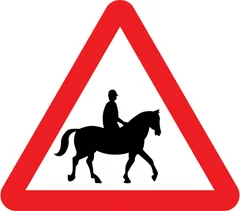
- Wild horses or ponies roaming freely
- Horse-drawn vehicles on the road ahead
- Horses being ridden or led on the road
- A horse racing course entrance ahead
Answer: C. A rider on a horse in a red triangle warns that accompanied horses or ponies are likely to be in or crossing the road. Slow down, pass wide and quietly, and be ready to stop. A horse without a rider warns of wild horses or ponies instead. Reference: Know Your Traffic Signs
Q25. What does this sign warn you about?
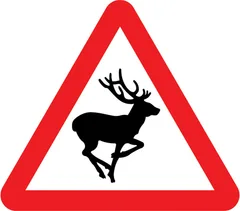
- Wild animals, such as deer, in the road
- The entrance to a deer park just ahead
- Farm animals being herded across the road
- A safari park or zoo is nearby
Answer: A. A leaping deer in a red triangle warns that wild animals are likely to be in the road. They can appear suddenly from the verges, so keep your speed down and look well ahead. Tourist attractions such as safari parks are signed with brown signs. Reference: Know Your Traffic Signs
Q26. What does this sign mean?
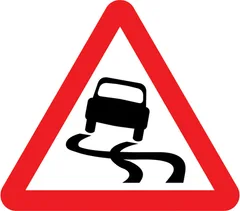
- Slippery road ahead
- Double bend ahead
- Uneven road surface
- Road liable to flooding
Answer: A. The skidding car warns that the road ahead may be slippery. Slow down in good time, avoid harsh braking, acceleration and steering, and leave a bigger gap. The wavy lines behind the car are skid marks, not a warning of bends. Reference: The Highway Code — Traffic signs
Q27. What does the 20% on this sign tell you?
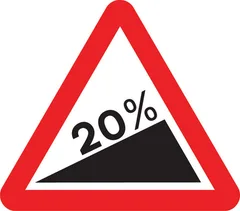
- The hill is 20 metres high
- Reduce speed by 20% on the hill
- The hill lasts for 20% of a mile
- It's a steep hill up, 1 in 5
Answer: D. This sign warns of a steep hill upwards, and the percentage shows the gradient. A 20% gradient is the same as 1 in 5, so the road rises one unit for every five it goes along. Be ready to change to a lower gear in good time. Reference: Know Your Traffic Signs
Q28. You're driving along a one-way street and see this sign. What does it mean?
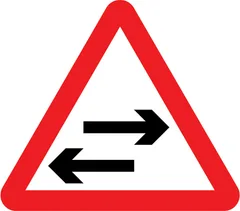
- Two-way traffic straight ahead
- The one-way street ends here
- A contraflow bus lane starts ahead
- Two-way traffic crosses ahead
Answer: D. Horizontal arrows pointing in opposite directions warn that a road carrying two-way traffic crosses your one-way road ahead, so expect vehicles from both left and right. Vertical arrows would warn of two-way traffic straight ahead on your own road. Reference: The Highway Code — Traffic signs
Q29. What does this sign mean?
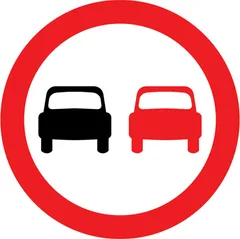
- No overtaking
- No motor vehicles
- Keep your distance
- Cars only — no lorries
Answer: A. A red ring means a prohibition. Two cars side by side, one of them red, show that overtaking is not allowed. The 'no motor vehicles' sign is different: it shows a motorcycle above a car inside the red ring. Reference: The Highway Code — Traffic signs
Q30. What does this sign mean?
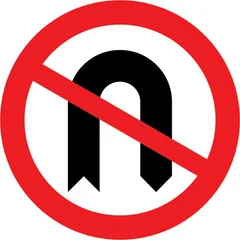
- No right turn
- Hairpin bend ahead
- No through road
- No U-turns
Answer: D. Where a change of direction is prohibited, a red bar is added across the symbol as well as the red ring. Here the symbol is a U-shaped arrow, so U-turns are banned. A hairpin bend would be warned of with a red triangle instead. Reference: Know Your Traffic Signs
Q31. Which vehicles are banned by this sign?
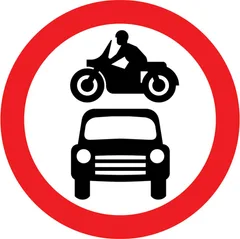
- All motor vehicles
- Motorcycles only
- Cars towing trailers
- Learner drivers and riders
Answer: A. A motorcycle and a car together inside a red ring mean no motor vehicles. A version showing only a motorcycle bans solo motorcycles, and one showing a car and caravan bans towed caravans. Plates beneath may show exceptions, such as for access. Reference: Know Your Traffic Signs
Q32. What does this plain white circle with a red ring mean?
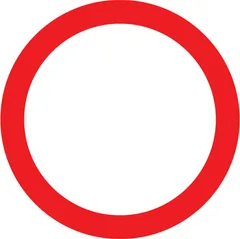
- The national speed limit applies here
- No entry — one-way street starts here
- No stopping or waiting at any time
- No vehicles, except bicycles pushed
Answer: D. An empty red ring means no vehicles may go past it, except pedal cycles pushed by hand. Don't confuse it with the national speed limit sign, which is a white circle crossed by a black diagonal band and has no red ring. Reference: The Highway Code — Traffic signs
Q33. You're approaching a narrow bridge and see this sign. What must you do?
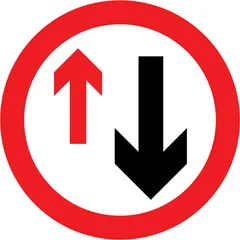
- Give way to vehicles coming towards you
- Go first — oncoming traffic must give way
- Keep left; two-way traffic ahead
- Wait for a green light before crossing
Answer: A. Circular red-ringed signs give orders. The small red arrow is your direction, so you must give priority to traffic from the opposite direction, usually waiting at a give way line. A blue rectangular sign with a larger white arrow means the opposite. Reference: Know Your Traffic Signs
Q34. What does this blue rectangular sign tell you?
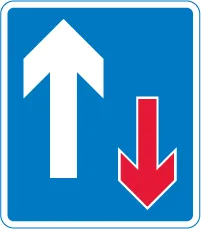
- You have priority over oncoming vehicles
- Give way to oncoming vehicles
- One-way traffic — nothing will come towards you
- A contraflow lane for buses on the right
Answer: A. Blue rectangles give information. The larger white arrow is your direction, so you have priority through the narrow section. Still take care, as an oncoming driver may not give way. A red-ringed circle with a small red arrow for you means you must give way. Reference: The Highway Code — Traffic signs
Q35. You're driving a tall van and see this sign. What does it mean?
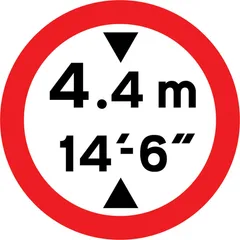
- No vehicles over the width shown
- No vehicles over the height shown
- No vehicles over the length shown
- Headroom shown is advisory only
Answer: B. Triangles pointing at the top and bottom of the figures show a height limit, given in metres and in feet and inches. In a red ring it's mandatory: it's unlawful for an overheight vehicle to pass. Width limits use arrows pointing in from the sides. Reference: Know Your Traffic Signs
Q36. What does this sign mean?
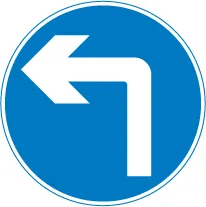
- No left turn ahead
- Keep to the left of the sign
- Turn left ahead
- Left turn advised for lorries
Answer: C. Blue circles give mandatory instructions. The arrow bends to the left, so you must turn left ahead. A straight arrow pointing left means 'turn left' at that point, and an arrow pointing diagonally down to the left means 'keep left'. Reference: The Highway Code — Traffic signs
Q37. What does this sign mean?
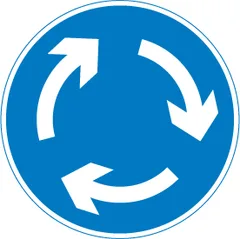
- Warning of a roundabout further ahead
- Mini-roundabout — give way to the right
- One-way system — follow the arrows round
- No through road — turn round here
Answer: B. A blue circle with three curved arrows marks a mini-roundabout. Give way to traffic from your immediate right and keep to the left of the central white circle unless your vehicle's size makes that impossible. A red warning triangle with arrows warns of a roundabout. Reference: Know Your Traffic Signs
Q38. A police officer is holding up this sign. What must you do?
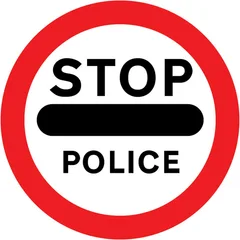
- Slow down and pass the officer with care
- Stop and don't go past the sign
- Stop only if people are crossing
- Pull in and have your licence ready
Answer: B. When displayed by a police officer or traffic warden, this sign means vehicles must not go beyond it. You must obey signals and signs given by police officers and traffic wardens. Wait until you're clearly directed to move on. Reference: Know Your Traffic Signs; The Highway Code — rule 105
Q39. What does this sign mean?
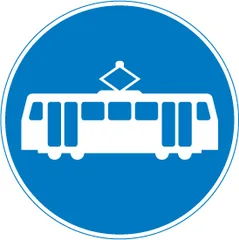
- Trams crossing ahead
- Tram stop — no waiting
- Route for trams only
- Park and ride by tram
Answer: C. Blue circles can mark a route reserved for particular vehicles. This one shows a tram, so other vehicles must not use the route. Since October 2025 the sign no longer needs an 'only' plate. A red triangle with a tram warns of trams crossing. Reference: The Highway Code — Traffic signs
Q40. What does this sign mean?
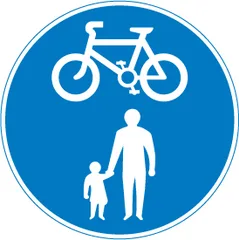
- Separate lanes for cyclists and pedestrians
- Cyclists must dismount and walk
- Shared route for cyclists and pedestrians
- No cycling or walking beyond this sign
Answer: C. A blue circle showing a cycle above pedestrians, with no dividing line, marks a route shared by pedal cycles and pedestrians only. When a vertical white line separates the symbols, cyclists and pedestrians use separate sides of a segregated route. Reference: The Highway Code — Traffic signs
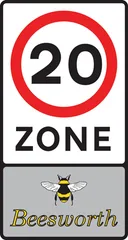
Q41. You drive past this sign into a housing estate. What does it tell you?
- 20 mph is advised only near the school
- A parking zone with a 20-minute limit
- 20 mph applies only to lorries and buses
- 20 mph limit — expect traffic calming
Answer: D. This is the entrance to a 20 mph zone. As well as setting a 20 mph limit, it warns that traffic-calming features such as road humps and narrowings may be found inside, often without individual signs. Keep to a steady low speed. Reference: Know Your Traffic Signs
Q42. What does this sign mean?
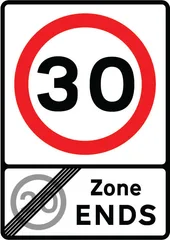
- A 30 mph zone ends; 20 mph starts
- The limit rises to 30 mph for cars only
- Speed cameras enforce 30 mph from here
- The 20 mph zone ends; a 30 mph limit starts
Answer: D. The lower panel, with a greyed-out 20 zone symbol and the word ENDS, shows you're leaving the 20 mph zone. The red ring above sets the new limit of 30 mph. Remember it's a maximum, not a target, so drive to the conditions. Reference: Know Your Traffic Signs
Q43. You see this plate beneath a bend warning sign. What does it mean?
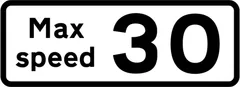
- 30 mph is now the legal speed limit
- You must do at least 30 mph here
- 30 mph is advised for the bend
- A speed camera is set at 30 mph
Answer: C. A rectangular 'Max speed' plate under a warning sign gives the maximum speed advised for the bend or hazard. It isn't a legal limit, but going faster could be dangerous. Legal maximum speed limits are shown inside a red circle. Reference: Know Your Traffic Signs
Q44. What does this sign tell you?
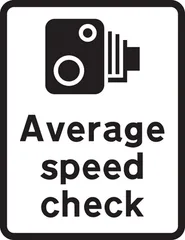
- Keep an average gap of two seconds here
- A mobile police speed check is in use
- The speed limit here is advisory only
- Your average speed is checked by cameras
Answer: D. This sign marks a length of road where two cameras measure your average speed between two points. Slowing down only as you pass a camera won't help: keep to the speed limit for the whole stretch. Reference: Know Your Traffic Signs
Q45. This signal lights up above your lane on the motorway. What does it mean?
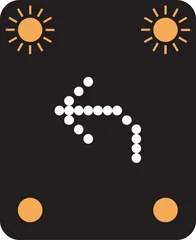
- Move into the lane on your left
- Leave the motorway at the next exit
- Services are available at the next exit
- The hard shoulder is open as a lane
Answer: B. A bent arrow on a motorway signal means you should leave at the next exit. A diagonal arrow would tell you to move into the adjacent lane instead. Obey the signal even if the reason isn't obvious — there may be an incident ahead. Reference: Know Your Traffic Signs; The Highway Code — Light signals controlling traffic
Q46. What does this sign mean during the times shown?
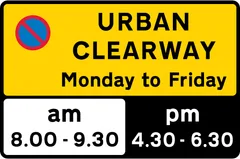
- No stopping for any reason, even briefly
- No waiting, but you may load and unload
- Bus lane — other traffic must keep out
- Stop only to pick up or set down
Answer: D. This is an urban clearway. During its hours you must not stop on the carriageway or verge except to pick up or set down passengers. A red cross on blue shown on its own marks a 24-hour clearway, where you can't stop even for passengers. Reference: The Highway Code — rule 240; Know Your Traffic Signs
Q47. You're driving along a road with this sign. Where may you stop?
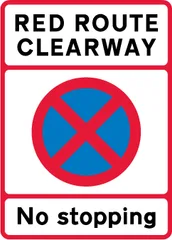
- Only in a marked lay-by
- On the verge or footway
- At the kerb, to drop someone off
- Anywhere outside peak hours
Answer: A. On a red route clearway, stopping for any purpose is banned at all times except in marked lay-bys. Unlike a rural 24-hour clearway, the ban covers the verge and footway too. There are usually no road markings, only repeated signs. Reference: Know Your Traffic Signs
Q48. This plate is next to yellow marks on the kerb. What may you still do here?
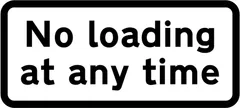
- Load or unload for up to 20 minutes
- Park if you display a parking disc
- Let passengers get in or out
- Unload if you're in a goods vehicle
Answer: C. Yellow kerb marks with this plate mean loading and unloading are banned at all times. You may still stop while passengers board or alight. Blue Badge holders may not park where loading restrictions are in force. Reference: The Highway Code — Road markings; Know Your Traffic Signs
Q49. What does this sign mean?
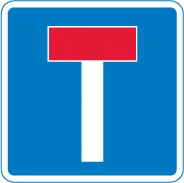
- T-junction ahead
- No through road
- Road closed to all traffic
- No entry for vehicles
Answer: B. This blue information sign means there's no through route for vehicles, so you'll have to turn round to get out. Don't confuse it with the red triangle warning of a T-junction, where the road you're on meets another road ahead. Reference: The Highway Code — Traffic signs
Q50. What does this sign tell you?
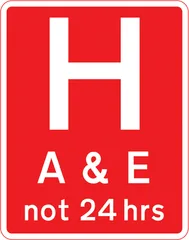
- Hospital ahead with an A&E department
- Hospital ahead with no A&E department
- Helicopter landing site for air ambulances
- Health centre open until late evening
Answer: A. Hospitals with accident and emergency departments are shown on red signs; 'not 24 hrs' means the A&E isn't open at all times. Blue hospital signs show a hospital without accident and emergency facilities. Reference: Know Your Traffic Signs; The Highway Code — Traffic signs
Q51. What does this sign mean?
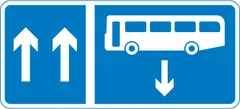
- A with-flow bus lane on the right
- A contraflow bus lane
- Two lanes, then a bus stop
- Buses must turn right ahead
Answer: B. The downward arrow in the bus lane shows buses travelling towards you, against the flow of other traffic. The upward arrows show the lanes available to you. Don't drive in the contraflow lane, and take care when turning across it. Reference: Know Your Traffic Signs
Q52. What does this warning sign mean?
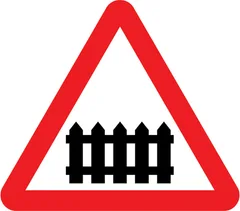
- Level crossing without barriers ahead
- Level crossing with barriers ahead
- A cattle grid across the road ahead
- Private road — gate closed ahead
Answer: B. The gate symbol warns of a level crossing with a gate or barrier ahead. Slow down and be ready to stop if the lights or alarms operate. A level crossing without a gate or barrier is shown by a steam locomotive symbol instead. Reference: The Highway Code — Traffic signs
Q53. Where would you see this sign?
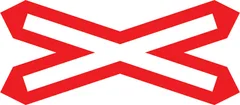
- At a crossroads where no one has priority
- Before a low railway bridge
- At a level crossing with full barriers
- At a level crossing with no barriers
Answer: D. The St Andrew's cross marks a level crossing without gates or barriers. At automatic crossings you must always stop when the traffic light signals show. Where there are 'give way' signs, look out for and give way to trains. Reference: Know Your Traffic Signs
Q54. What does this warning sign mean?
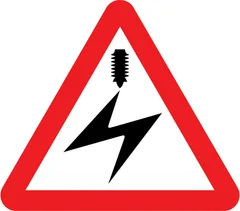
- Risk of lightning strikes
- Overhead electric cable ahead
- Electricity substation ahead
- Speed camera with flash ahead
Answer: B. The lightning symbol warns of an overhead electric cable, often where a railway or tramway crosses the road. A plate may show the maximum height of vehicle that can pass safely beneath it, which matters if you're driving a tall vehicle. Reference: The Highway Code — Traffic signs
Q55. A road worker holds up this sign. What must you do?
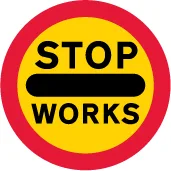
- Slow down and pass the works carefully
- Stop and wait until you're allowed on
- Stop only if workers are in the road
- Turn round — the road is closed
Answer: B. This hand-held sign is shown for short periods during works on or near the road. Vehicles must not go beyond it while it's displayed. Wait patiently: it's there to protect the workforce and other road users. Reference: Know Your Traffic Signs
Q56. You turn into a street and pass this sign. How should you drive?
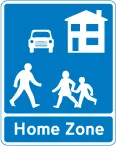
- Normally — it just names the estate
- At 20 mph, with priority over walkers
- Sounding your horn to warn people
- Slowly, ready to stop for people
Answer: D. This marks the entrance to a Home Zone, a residential area where the road space is shared and people may use the whole street. Drive slowly and carefully, and be prepared to stop to give people extra time to make room for you. Reference: Know Your Traffic Signs
Q57. What does a sign like this, with a brown background, show?

- The way to a tourist attraction
- A route recommended for lorries
- A temporary diversion route
- A local, non-primary route
Answer: A. Brown signs direct you to tourist attractions and facilities, often with a symbol. This one shows the direction and distance to the attraction. Lorry routes use black signs, temporary diversions use yellow and non-primary routes use white. Reference: Know Your Traffic Signs
Q58. What does the blue background on this direction sign tell you?
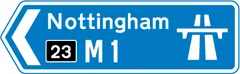
- The route is a primary A road
- The route leads to a tourist site
- The route is only for local traffic
- The route leads to a motorway
Answer: D. Blue direction signs are used for motorways. This one, with the motorway symbol, shows the M1 can be reached from the junction, with the junction number on a black background. Green signs are for primary routes and white signs for non-primary routes. Reference: Know Your Traffic Signs
Q59. What does this sign warn you about?
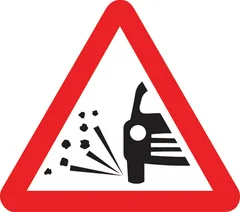
- Falling rocks from a cliff
- A quarry entrance ahead
- Uneven road surface
- Loose chippings ahead
Answer: D. Stones flying from a car's wheels warn of loose chippings on the road, often after resurfacing. Slow down: chippings reduce grip and can be thrown up by tyres. A plate may advise a maximum speed, such as 20 mph. Reference: Know Your Traffic Signs
Q60. What does this sign warn of?
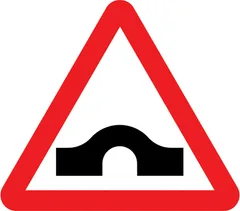
- A tunnel entrance
- A road hump
- A hump bridge
- An uneven road
Answer: C. The arched symbol warns of a hump bridge. The road rises sharply, so you may not see oncoming traffic until late. Slow down and keep to the left. The road hump sign shows a much lower, flatter bump. Reference: The Highway Code — Traffic signs
Q61. You're following direction signs for a primary route. What colour background will they have?
- Green
- Blue
- White
- Brown
Answer: A. Primary routes are roads of national or regional importance and always have 'A' numbers. Their direction signs have green backgrounds, white lettering and yellow route numbers. Blue is used for motorways, white for non-primary routes and brown for tourist destinations. Reference: Know Your Traffic Signs
Q62. A direction sign has a white background, black lettering and a black border. What sort of route is it on?
- A primary route between major towns
- A motorway or motorway slip road
- A temporary diversion route
- A non-primary or local route
Answer: D. Signs on non-primary and local routes have white backgrounds with black lettering and route numbers, and black borders. This includes local roads with 'A' numbers that aren't primary routes. A green panel on such a sign shows a primary route starting at the junction. Reference: The Highway Code — Traffic signs
Q63. Away from motorways, what are blue rectangular signs mainly used for?
- Giving information
- Giving orders you must obey
- Warning of hazards ahead
- Showing tourist routes
Answer: A. Rectangles inform. Blue rectangles are used for information signs, such as 'no through road', except on motorways, where blue is the colour of direction signs. Blue circles are different: they generally give mandatory instructions. Reference: Know Your Traffic Signs
Q64. On a green direction sign, a motorway number is shown in brackets on a blue patch, without the motorway symbol. What does this mean?
- The junction leads straight onto the motorway
- The motorway is closed at this junction
- This road leads to the motorway further on
- Only motorway traffic may use this route
Answer: C. Route numbers in brackets are roads you'll reach by following the route shown. A motorway number in brackets on blue, without the motorway symbol, means you can't join the motorway directly from this junction. Signs with the motorway symbol show direct access. Reference: Know Your Traffic Signs
Q65. A 'no right turn' sign has a plate beneath it showing times. What does the plate mean?
- The ban applies only during those times
- Right turns are allowed only at those times
- It shows when the traffic lights change
- It shows the times the road is gritted
Answer: A. Plates below signs qualify their message. A time plate under a 'no right turn' or 'no left turn' sign makes it a part-time ban, so you must not turn during the times shown. Outside those times you may turn if it's safe. Reference: The Highway Code — Traffic signs; Know Your Traffic Signs
Q66. You're on a road with street lights, but you pass small repeater signs showing the national speed limit. What does this tell you?
- The national speed limit applies here
- 30 mph applies, because of the street lights
- The lights are off, so there's no limit
- The limit changes to 20 mph at night
Answer: A. Street lighting usually means a 30 mph limit (20 mph in Wales) unless signs show otherwise. National speed limit repeater signs are used only on lit roads other than motorways, to remind you that the national limit applies despite the lights. Reference: Know Your Traffic Signs
Q67. An area of white diagonal stripes in the centre of the road is bordered by a broken white line. What should you do?
- Use it as an extra overtaking lane
- Keep out unless it's needed and safe
- Never enter it, even in an emergency
- Stop in it if you need to take a call
Answer: B. Hatched areas separate traffic lanes or protect traffic turning right. If the area is bordered by a broken white line, you should not enter it unless it's necessary and you can see it's safe. If bordered by a solid line, you must not enter except in an emergency. Reference: The Highway Code — rule 130
Q68. You're overtaking where double white lines have a broken line on your side. White arrows on the road then start pointing left. What do they mean?
- Turn left at the junction just ahead
- Move back to your side of the road
- The left-hand lane is ending soon
- You may now overtake on the left
Answer: B. Where the line nearer to you is broken, you may cross to overtake if it's safe and you can finish before reaching a solid line on your side. White direction arrows on the road show that you need to get back onto your side of the road. Reference: The Highway Code — rule 128
Q69. You're driving at night on an unlit single carriageway road. What colour are the reflective studs marking the middle of the road?
- Red
- Amber
- White
- Green
Answer: C. White studs mark the lanes or the middle of the road. Red studs mark the left edge of the road, amber studs mark the central reservation of a dual carriageway or motorway, and green studs mark the edge of the main carriageway at lay-bys and slip roads. Reference: The Highway Code — rule 132
Q70. At a roundabout controlled by traffic signals, the circulating road has a yellow box junction. When may you enter the box?
- Whenever your traffic light is green
- When only oncoming traffic stops your right turn
- Only if you can cross it without stopping
- Once the vehicle in front starts to move
Answer: C. Normally you mustn't enter a box junction unless your exit is clear, though you may wait in it to turn right when blocked only by oncoming or right-turning traffic. At signalled roundabouts there's no such exception: you must be able to cross the box completely without stopping. Reference: The Highway Code — rule 174
Q71. You're in a slow queue, and ahead 'KEEP CLEAR' is painted across the road outside a side road. What should you do?
- Stop on it if no one is waiting to come out
- Stop on it, but only for a few seconds
- Use it to pull over and let traffic pass
- Wait so that you don't stop on the marking
Answer: D. 'KEEP CLEAR' marks an area of road to be kept free of stationary traffic, usually so vehicles can get into or out of a side road or access. Hold back so you don't stop on it, even if nobody seems to be waiting. Reference: Know Your Traffic Signs
Q72. A single yellow line runs along the edge of the road and its restrictions are in force. Where do they apply?
- Only the road itself
- The road and verge, but not the pavement
- The road, the pavement and the verge
- Only the side of the road with the time plate
Answer: C. Waiting restrictions shown by yellow lines apply to the carriageway, pavement and verge. Parking with two wheels up on the pavement beside the line still breaks the restriction during its hours. Check the time plate, or zone entry sign, to see when it applies. Reference: The Highway Code — Road markings; rule 238
Q73. There's a single short yellow mark on the kerb at intervals along the road. What does it mean?
- No loading at the times on the plate
- No loading or unloading at any time
- No waiting at any time of day
- Loading is only allowed at those times
Answer: A. Yellow kerb marks show loading restrictions. A single mark means loading and unloading are banned during the times shown on nearby plates; a double mark means no loading at any time. You may still stop while passengers get in or out. Reference: The Highway Code — Road markings; Know Your Traffic Signs
Q74. On a red route, a parking box is marked out in red rather than white. What does this tell you?
- It's available at all times of the day
- It's reserved for licensed taxis only
- It's available only for part of the day
- It's for Blue Badge holders only
Answer: C. On red routes you may stop in specially marked boxes, with signs showing the times, purposes and durations allowed. A box marked in red may be available for its purpose only for part of the day; a box marked in white is available throughout the day. Reference: The Highway Code — Road markings
Q75. Where does the ban on parking at a zebra crossing's zig-zag lines apply?
- Only on the side you approach from
- Only when people are waiting to cross
- Anywhere on them, on both sides
- Only on the black and white stripes
Answer: C. Zig-zag lines help drivers and pedestrians see each other clearly. You must not park anywhere within them, before or after the crossing. The same applies at crossings for cyclists and horse riders that have zig-zag markings. Reference: Know Your Traffic Signs; The Highway Code — rule 240
Q76. On a dual carriageway, you hear a loud rumble and feel vibration as your tyres run onto the white edge line. Why?
- It's a rumble strip for a junction ahead
- The road surface is breaking up
- A speed camera zone has started
- The line has raised ribs to warn you
Answer: D. Some edge lines have raised ribs that give an audible and tactile warning when you cross them. They're used on motorways and other roads with hard shoulders or hard strips. If you feel them, you're drifting out of your lane — correct gently and stay alert. Reference: Know Your Traffic Signs
Q77. At UK traffic lights, which signal comes straight after red?
- Green
- Amber on its own
- Red and amber together
- Flashing amber
Answer: C. The sequence is red, red and amber, green, amber, then red again. Red and amber together still means stop: don't pass the stop line until green shows. A flashing amber phase is used at pelican crossings, not at ordinary traffic lights. Reference: The Highway Code — Light signals controlling traffic
Q78. At traffic lights, one lane is marked for a green filter arrow pointing left. You want to go straight ahead. What should you do?
- Use it, then go ahead when the arrow shows
- Use it only while the main light is green
- Wait in it until the full green shows
- Stay out of that lane
Answer: D. A green filter arrow shows a filter lane only. Don't enter that lane unless you want to go in the direction of the arrow. Traffic in it may go when the arrow or the full green shows, so waiting there to go ahead would hold others up. Reference: The Highway Code — rule 177
Q79. You want to turn right at a junction. The full green light is showing, and a green right-turn arrow lights up alongside it. What does this mean?
- Oncoming drivers must now give way, so you needn't check
- You must now wait until the full green light goes out
- Only buses and cycles may turn right while it shows
- It's easier now, but check oncoming traffic has stopped
Answer: D. You may turn right on a full green anyway, giving way to oncoming traffic. A right-turn arrow at the same time means turning should be easier, but always check opposing traffic has stopped. If the full green changes to an ahead or left arrow, wait for the right arrow. Reference: Know Your Traffic Signs
Q80. You're first at a junction. The traffic light at your stop line isn't working, but the signal for your direction on the far side shows red. What should you do?
- Obey the far-side signal and wait
- Treat it as an unmarked junction
- Go, as your own light isn't working
- Flash your lights and go if clear
Answer: A. Most junctions have secondary signals on the far side as well as primary signals at the stop line. If the primary signal isn't working, you must obey the secondary signal as if it were the primary. Only when the lights aren't working at all do you treat it as an unmarked junction. Reference: Know Your Traffic Signs; The Highway Code — rule 176
Q81. You're driving past a fire station when a pair of red lights starts flashing alternately. What must you do?
- Slow down and go on with care
- Stop only if you see a fire engine
- Stop
- Give way to traffic from the right
Answer: C. Alternately flashing red lights mean you must stop. They're used at level crossings, lifting bridges, airfields and fire stations. Wait until they go out, as an emergency vehicle may be about to pull out even if you can't see it yet. Reference: The Highway Code — Light signals controlling traffic
Q82. A street ahead is closed by rising bollards with red and green signals. A bus goes through on green. You're not in an authorised vehicle. What should you do?
- Follow it closely before the bollards rise
- Wait for the next green, then drive through
- Don't follow it through
- Sound your horn to warn the bus
Answer: C. Rising bollards limit a street to certain vehicles, such as buses. Only one vehicle should pass at a time, and only on green. If you're not driving an authorised vehicle, don't follow the one in front: you risk injury and damage to your car. Reference: Know Your Traffic Signs
Q83. A police officer directing traffic is facing you with one arm raised straight up and the palm towards you. What does this mean?
- Come on towards me
- Turn to the left
- Speed up and clear the junction
- Stop
Answer: D. This is the police signal to stop traffic approaching from the front. You must obey signals given by police officers and traffic officers. Wait until the officer beckons you on — don't move just because the road looks clear. Reference: The Highway Code — Signals by authorised persons; rule 105
Q84. A police officer controlling traffic has their back to you, with one arm held out to the side and the palm facing you. What must you do?
- Stop
- Pass on the officer's left
- Carry on — it's for traffic in front
- Overtake the queue slowly
Answer: A. An officer with their back to you and an arm held out, palm towards you, is stopping traffic approaching from behind, which includes you. The Highway Code shows separate police signals for stopping traffic from the front, from behind, and from both directions at once. Reference: The Highway Code — Signals by authorised persons
Q85. The driver of the car ahead holds their right arm out of the window and moves it up and down. What does this mean?
- They intend to slow down or stop
- They want you to overtake
- They intend to turn right
- They're warning of a hazard behind
Answer: A. This arm signal means 'I intend to slow down or stop'. Arm signals are used when indicators aren't used, or to reinforce indicators and brake lights. An arm held straight out without moving means moving out to the right or turning right. Reference: The Highway Code — Signals to other road users
Q86. A police officer is controlling traffic at a junction and you want to go straight on. How can you show them?
- Point across the car to your left
- Hold your right arm straight out
- Hold up a hand, palm facing forward
- Flash your headlights at the officer
Answer: C. The Highway Code shows arm signals for telling a person controlling traffic what you intend. Going straight on is a raised hand with the palm forward. To turn left, point to the left with either hand; to turn right, hold your right arm out of the window. Reference: The Highway Code — Signals by authorised persons
Q87. Approaching a roundabout on a fast road, you drive over yellow bars painted across your lane that get closer together. Why are they there?
- To mark an area where you mustn't stop
- To show where the give way line will be
- To warn of a speed camera ahead
- To encourage you to slow down
Answer: D. Some roundabouts have yellow bar markings on the approach. The bars become closer together the nearer you get to the roundabout, warning you to slow down. Check your speed and be ready to give way to traffic from the right. Reference: Know Your Traffic Signs
Q88. A vehicle ahead of you shows flashing amber lights, and a DVSA officer inside signals you to follow it. What should you do?
- Overtake — it's a slow-moving vehicle
- Ignore it, as only police can stop you
- Follow it to a safe place to stop
- Stop at once, even in a live lane
Answer: C. Driver and Vehicle Standards Agency officers can stop vehicles on all roads, including motorways. Flashing amber lights from in front of you are a request to follow them to a safe place to stop. It's an offence not to comply with their directions. Reference: The Highway Code — rule 107
Q89. A police car behind you flashes its blue lights and the officer points to the left. What must you do?
- Brake hard and stop where you are
- Pull over safely, stop, switch off
- Keep going to the nearest police station
- Slow down and let the car overtake you
Answer: B. Police usually signal from behind with flashing blue lights, headlights or a siren, and point or use the left indicator. You must pull over and stop as soon as it's safe, then switch off your engine. Don't stop somewhere dangerous or carry on driving. Reference: The Highway Code — rule 106
Q90. A school crossing patrol at the kerb holds their sign out at an angle towards the road. What does this tell you?
- Be ready to stop for people crossing
- Children have finished crossing — go on
- They're signalling that you may pass
- The patrol is off duty for the day
Answer: A. The Highway Code shows a patrol holding the sign out at an angle to mean they're ready to cross pedestrians, so vehicles must be prepared to stop. When the patrol shows the 'Stop for children' sign held upright, all vehicles must stop. Reference: The Highway Code — Signals by authorised persons; rule 210
Frequently asked questions
How many Road & Traffic Signs questions are in the real theory test?
The DVSA doesn't publish per-topic counts. Your 50 questions are drawn across all 14 official topics, so revise every category.
What is the pass mark for the UK theory test?
You need 43 out of 50 multiple-choice questions correct (86%), plus 44 out of 75 on the hazard perception clips. You must pass both parts in the same sitting.
Are these real DVSA questions?
No — these are original practice questions written to the current DVSA syllabus and The Highway Code. Official revision questions are Crown Copyright and only available from licensed providers.
Revise the other theory test topics
Your 50 test questions are drawn from all 14 official DVSA topics — revise every category, not just this one.
- Alertness
- Attitude
- Essential Documents
- Hazard Awareness
- Incidents, Accidents & Emergencies
- Motorway Rules
- Other Types of Vehicle
- Rules of the Road
- Safety & Your Vehicle
- Safety Margins
- Vehicle Handling
- Vehicle Loading
- Vulnerable Road Users
Don't forget part two: read how hazard perception is scored. Booked your test? Find your nearest theory test centre, or book on the official GOV.UK booking service (£23).
Traffic sign images: Crown copyright, Department for Transport. Reproduced under the Open Government Licence v3.0. Licence.
All practice questions are original study material written to the current DVSA car theory test syllabus and The Highway Code. They are not actual DVSA exam questions. This site is an independent study resource and is not affiliated with or endorsed by the DVSA.